
Built to work.
Not to demo.
Custom automation and AI infrastructure designed to remove operational drag, eliminate manual coordination, and give your team the systems modern businesses actually need. Not features. Not chatbots. Real work, automated.
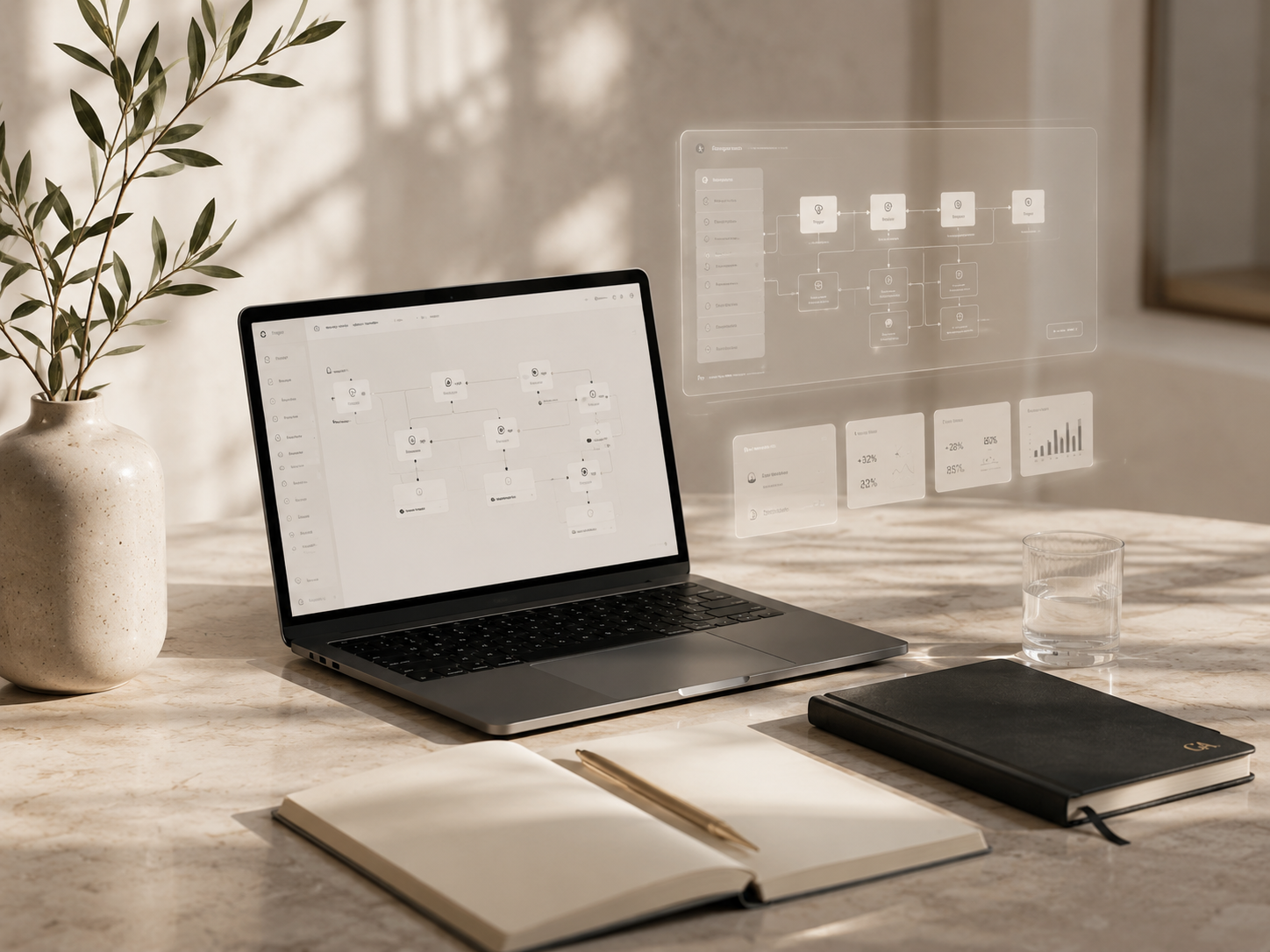
Most businesses bought AI. They didn't build operations.
Generic tools and bolt-on AI features don't remove operational drag. They create more complexity, more subscriptions, and more workarounds.
Real impact comes from designing systems around your business — then automating the work that shouldn't need human effort in the first place.
We build the infrastructure, governance, and workflows that make AI useful, reliable, and embedded in how your business actually runs.
Growth Assembly builds automation that integrates, governs, and scales.
We design real workflows, connect your systems, and implement AI where it removes friction and drives outcomes.
Operational clarity. Measurable impact. Reliable systems that run every day.
What AI & Automation covers
Operations Audit and Architecture
We map your processes, systems, and data to identify automation opportunities and design the right architecture.
Custom AI Workflows
Purpose-built workflows using AI for document processing, triage, routing, summarisation, approvals, and more.
Systems Integration
We connect your tools, data, and platforms so information flows seamlessly across your business.
Governance and Oversight
We implement controls, permissions, audit trails, and human-in-the-loop checks to keep automation reliable and compliant.
How an engagement runs
Operations audit and opportunity mapping
We review your current systems, processes, and data to identify friction points, risks, and high-value automation opportunities.
Architecture and design
We design the target-state workflows, system architecture, data flows, AI logic, and governance model aligned to your business goals.
Build, integrate and test
We build the automations, integrate your systems, test end-to-end, and validate performance, accuracy, and security.
Launch, training and ongoing optimisation
We launch with your team, provide training, and continuously optimise workflows based on real-world usage and outcomes.
Two tiers. One integrated systems team.
The cost of buying back hundreds of hours a year — usually within the first quarter.
- ✓ Automation opportunity audit and workflow architecture
- ✓ 3-5 production-ready automations
- ✓ Integration with existing tools and internal processes
- ✓ AI-assisted routing, summarisation, triage, or decision support
- ✓ QA testing, documentation, team training, and workflow handover
- ✓ 45 days of post-launch optimisation
An operating system for your business — replacing the people, tools, and workarounds you've outgrown.
- ✓ Full operations audit, AI systems architecture, and implementation roadmap
- ✓ Custom AI workflows for document processing, reporting, approvals, and decision support
- ✓ Multi-system integrations
- ✓ Operational dashboards and human-in-the-loop controls
- ✓ Role-based access, audit trails, governance documentation, and QA protocols
- ✓ Team training, SOPs, executive handover, and launch support
- ✓ 90 days of post-launch optimisation included
Why this engagement is different from generic automation work.
Built for production, not demos.
We design and build systems that run the work in real world — measurable, tested, and reliable.
Integrated with your real stack.
No rip-and-replace. We work with your tools, data, and processes to deliver seamless outcomes.
Governed and accountable.
Security, auditability, and human oversight are built in from day one — not bolted on later.
Designed to evolve.
We build with flexibility so your systems can adapt as your business, data, and needs grow.
Aldari Property — Operations automation infrastructure
We implemented AI-assisted maintenance triage, document processing, tenant communications, reporting, and daily summarised operational insights across property management operations.

Common questions
How do you decide what to automate? +
The audit phase maps every recurring process, the volume of work it consumes, the systems it touches, and the failure modes it creates. We then score each candidate by business impact, technical feasibility, and risk. Automation is only recommended where the math works — high-frequency, well-defined, and meaningfully expensive to keep doing manually. We don't automate for the sake of automating.
Will this require us to change our existing systems? +
Usually no. We work on top of your existing stack — CRM, ERP, finance, communication, storage — through APIs and integrations. Where systems need replacing, we'll say so honestly during the audit, and we'll never recommend a rip-and-replace where it isn't required. Most clients keep their full existing tooling and gain a coordination and intelligence layer on top.
What about data security and compliance? +
Every implementation is architected with role-based access, audit logs, encryption in transit and at rest, and human-in-the-loop checkpoints for sensitive workflows. We work within your existing security frameworks and can comply with UAE PDPL, GDPR, ISO 27001, and SOC 2 requirements when the engagement calls for it. Compliance scope is defined and signed off at architecture stage, not retrofitted later.
Do you build with proprietary AI or open-source models? +
Both. The model choice depends on the workflow — frontier models (OpenAI, Anthropic, Google) for general reasoning and language tasks, open-source models (Llama, Mistral, Qwen) for sensitive data that needs to stay on-premise, and specialised models for vision, OCR, voice, or domain-specific tasks. We architect for model-agnostic deployment so you're never locked to a single provider.
What happens when the AI gets something wrong? +
Every AI workflow is designed with failure modes mapped in advance. Confidence scoring, human-in-the-loop checkpoints, fallback logic, and exception queues are all standard. High-stakes decisions are always routed through human approval. Lower-stakes decisions are monitored, logged, and reviewed in optimisation cycles. AI failure is not a question of "if" — it's a question of "how the system handles it gracefully when it happens."
What does Managed AI Ops include? +
Ongoing monitoring of automation performance, accuracy drift detection, prompt and model updates as providers release new versions, integration maintenance as upstream APIs change, exception queue review, and a defined number of hours each month for new automations, refinements, and team support. Effectively, we keep the system running and improving so your team doesn't have to.
Can you work alongside our internal IT or data team? +
Yes — this is often how engagements run. We integrate into your team's existing workflows, defer to your IT team on infrastructure decisions where appropriate, and document everything so internal teams can take ownership of maintenance over time if they choose to. We're equally comfortable as the long-term partner or as a knowledge-transfer team that builds and then steps back.
What's not included in the pricing? +
Third-party API and model usage costs (OpenAI, Anthropic, Google, etc. — billed at cost, not marked up), SaaS subscriptions, infrastructure hosting beyond what's defined in scope, and significant new workflows added after the engagement begins. These are flagged transparently during scoping and again before any spend is incurred — never billed retroactively.
The point of automation isn't speed. It's leverage.
Real automation gives your team back their judgment, their time, and their attention. The systems run the work. The people run the business.
Ready to remove the work that shouldn't exist?
A 10-minute call. Mutual fit check. No pitch, no pressure — just a focused conversation about where AI and automation could actually move your operations forward.
Book a Discovery Call →Or email hello@growth-assembly.com